
Freelance writing for beginners is one of the most accessible ways to earn money online, because you can start with skills you already have — clear writing, curiosity, and reliability — instead of expensive equipment or a large audience. Businesses, blogs, and publications constantly need articles, website copy, emails, and guides, and they pay freelance writers to produce them.
This guide explains freelance writing for beginners from scratch: the types of writing that pay, a realistic step-by-step plan to land your first client, the mistakes new writers should avoid, and what results you can honestly expect. No overnight-income promises here — freelance writing rewards useful work and consistency, usually over months, not days.

Freelance Writing for Beginners: What Clients Actually Pay For
Clients rarely pay for words alone. They pay for a result: a blog post that ranks on Google, a landing page that converts visitors, or an email that gets opened. The main types of freelance writing for beginners are:
1. Blog and SEO content writing
Articles and guides written for company blogs, usually optimized for search. This is the easiest entry point for beginners, because demand is huge and the format is familiar. Rates vary widely, and beginners often start around $0.05 to $0.15 per word for general content, with higher rates in specialized niches.
2. Copywriting
Short, persuasive writing for websites, ads, sales pages, and emails. Copywriting usually pays more than general blog writing because it is tied directly to sales, but it also demands sharper skills and proof that your copy works.
3. Technical and B2B writing
Guides, white papers, and case studies for software, finance, healthcare, and other specialized industries. These niches pay the highest rates because they require real subject knowledge — but they are also the best long-term target once you have experience.
4. Editing and rewriting
Polishing, restructuring, and fact-checking drafts, including AI-assisted drafts that need a human editor. This is a growing niche for beginners with a sharp eye, and it is a realistic first service if you are not yet confident writing from scratch.
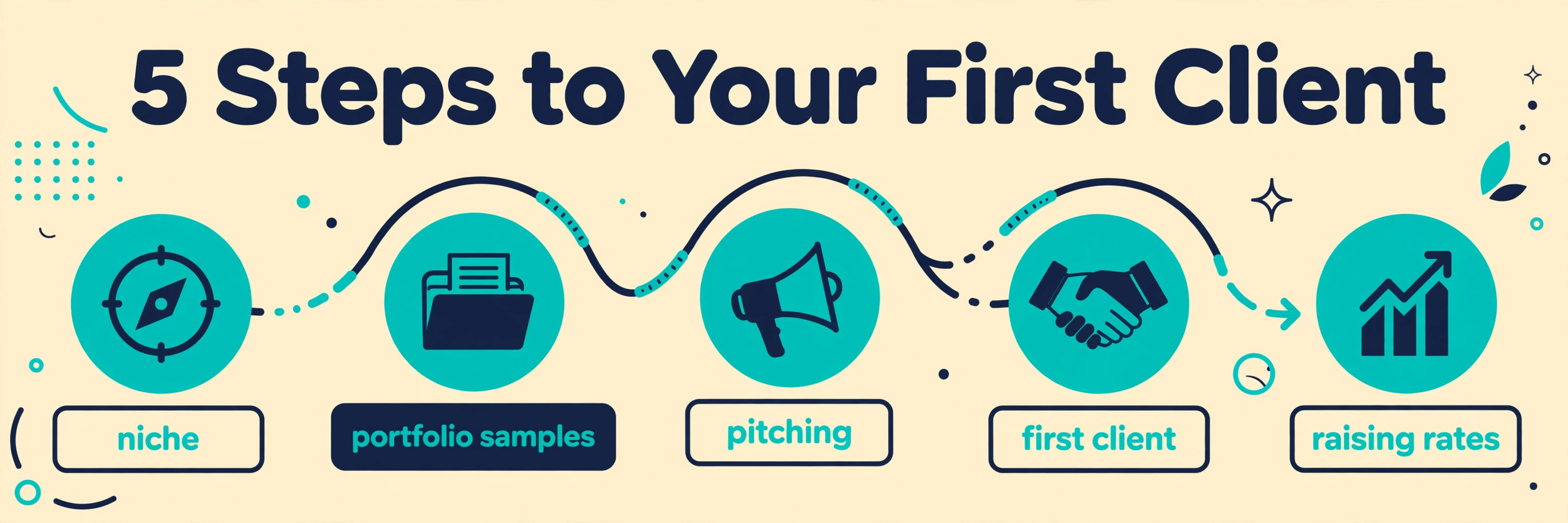
Step-by-Step Breakdown: Freelance Writing for Beginners
Step 1: Pick one niche and one type of writing
Choose a topic you already know or can research quickly, such as personal finance, health, tech, travel, or digital marketing, and one format, such as blog posts. Specialists earn more than generalists, because clients trust a writer who understands their audience. You can broaden later; start narrow.
Step 2: Write three strong samples before you pitch anyone
You do not need paying clients to build a portfolio. Write three sample pieces in your niche, at the length and style your target clients actually publish — for blog writing, around 1,000 to 1,500 words each with clear headings. Publish them on a simple portfolio page, a free blog, or a Medium profile so clients can read them.
Step 3: Set starting rates you can live with
A realistic beginner range is roughly $0.05 to $0.25 per word, or $25 to $50 per hour, depending on the niche and project. Quote per project when you can, since it rewards speed as you improve. Plan to raise your rates every few months as you gain testimonials and results — undercharging forever is the most common beginner trap.
Step 4: Pitch 10 businesses a week
Cold pitching — a short, targeted email to a business or editor — consistently beats waiting on job boards. A good pitch has three parts: a specific compliment about their content, one line about your relevant samples, and one concrete article idea for them. Ten pitches a week for a few months is a realistic path to a first client; most pitches will be ignored, and that is normal.
Step 5: Find early work on marketplaces too
Platforms such as Upwork, Fiverr, and Contra can bring your first paid jobs and reviews while your pitches go out. Competition is heavy and fees apply, so treat marketplaces as a starting ramp, not your forever home. Our beginner guide to starting freelancing on Upwork covers the platform side in detail.

Step 6: Deliver early, then ask for more work
Hit your deadline, follow the brief exactly, and deliver clean copy that needs little editing. Then ask for a short testimonial and whether they have more work coming. One happy repeat client is worth far more than ten one-off gigs, and referrals are how most established writers fill their calendars.
Step 7: Treat it like a business from day one
Use a simple contract for every project, send professional invoices, and track your time so you know your true hourly rate. In the US, set aside roughly 25 to 30 percent of each payment for taxes, since freelancers generally pay estimated taxes quarterly. Keep records from the start — future you will be grateful.
Mistakes to Avoid in Freelance Writing for Beginners
Writing for free indefinitely instead of building toward paid work. Accepting every topic instead of building a niche clients remember. Pitching with a generic "I write content" message instead of a specific idea. Working without a contract and then facing endless free revisions. Quitting after the first twenty unanswered pitches — pitching is a numbers game with a long tail. Copying AI output without fact-checking or rewriting it in your own voice, which clients notice fast.
What to Expect Realistically
Most beginners take weeks to a few months to land a first paid client, and 12 to 24 months of consistent pitching and publishing before freelance writing can support a full-time income — if it ever does. Early months usually mean small projects and modest pay. Results vary with niche, writing quality, pitching consistency, and timing, and generalist blog writing pays less than it used to as AI handles generic filler. Writers who specialize, show real expertise, and deliver measurable results are the ones who keep getting hired. For more beginner earning ideas, browse our Online Earning hub.
FAQs About Freelance Writing for Beginners
Do I need a degree to become a freelance writer?
No. Clients care about your portfolio, your niche knowledge, and whether you hit deadlines — far more than a journalism or English degree. Strong samples can stand in for formal qualifications.
How do I start freelance writing with no experience?
Pick a niche, write three sample pieces in that niche, publish them somewhere clients can read them, and start pitching businesses in that niche while also trying one freelance marketplace. Experience follows the first few paid projects.
How much can a beginner freelance writer earn?
It varies widely. Beginners often start around $0.05 to $0.15 per word for general content, while specialized writers can reach $0.35 to $1.00 or more per word with experience. Your first months will likely be modest — treat early income as proof of concept, not a salary.
Where do I find freelance writing jobs?
Start with direct pitches to businesses in your niche, plus one marketplace such as Upwork or Contra, and writing job boards such as the ProBlogger Job Board. LinkedIn is also useful once your profile shows your samples and niche clearly.
Can AI replace freelance writers?
AI has replaced generic, low-effort writing, but clients still pay for original research, subject expertise, interviews, a distinct voice, and careful editing — work AI cannot fully do on its own. Writers who offer those things are in a stronger position than ever.
Disclaimer: This guide is for education only. Earnings depend on many factors and are never guaranteed. Any rate ranges mentioned are industry-reported figures shared for learning, not a promise of similar results.
